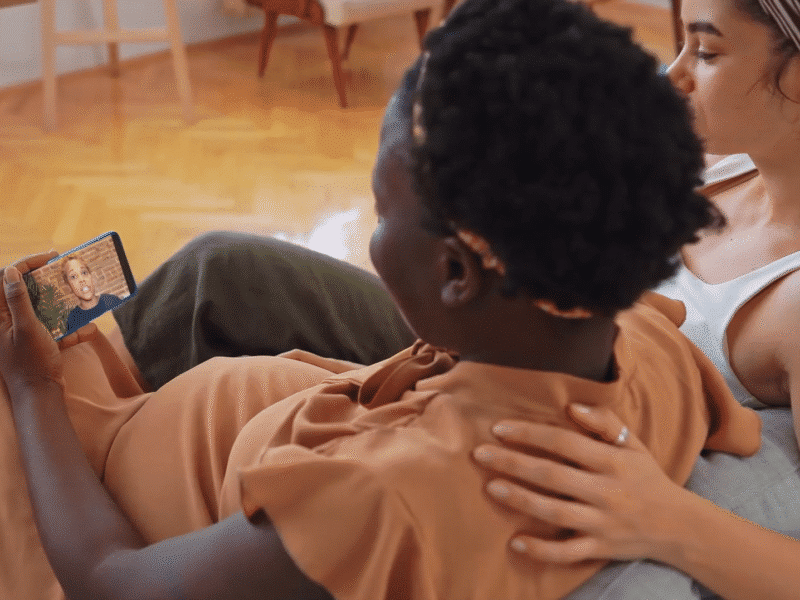

A group of Maryland moms sat down, virtually but candidly, to talk about what it’s really like after having a baby: the stress, the isolation, the constant juggling.
What surprised them most wasn’t what they shared, but what they heard.
“Some of the things I’m hearing… I feel like I’m not the only one,” one participant said, capturing a common thread. Struggles that felt deeply personal were, in fact, widely shared.
Those conversations are now shaping a new intervention aimed at tackling a growing and deeply intertwined health challenge: obesity and postpartum depression.
For the Johns Hopkins Center for Communication Programs’ August Summers, PhD, who led the sessions, hearing participants recognize they weren’t alone is exactly the point.
“When you create space for people to talk honestly about their experiences, you realize very quickly how much is being carried quietly,” he said. “And how important it is to design support that actually meets people where they are.”
Backed by a $150,000 Johns Hopkins Discovery Award, part of a university-wide effort to support cross-disciplinary collaboration, researchers across public health, nursing, internal medicine, and psychiatry are working to build an intervention called “Healthy for Two Plus,” an enhanced version of an existing program that supports women during pregnancy and after birth.
The original “Healthy for Two” is a virtual behavioral program that helps women manage weight during and after pregnancy through personalized coaching, a mobile app, and a connected smart scale. But as researchers delivered the program, a pattern emerged.
“To really engage in and sustain these health behaviors, mood really matters,” said Kelly Bower, PhD, an associate professor at the Johns Hopkins School of Nursing. “When people aren’t feeling well, when they’re stressed or overwhelmed, it’s much harder to follow through.”
That insight led the team to partner with colleagues in psychiatry to incorporate elements of “Mothers and Babies,” an evidence-based program that helps prevent postpartum depression. Rather than combining the two programs wholesale, the goal is to thoughtfully integrate key strategies, enhancing “Healthy for Two” without overwhelming participants.
The effort is being guided by CCP, which is leading a human-centered design process and bringing mothers directly into the development of the program.
In workshops, women who had already participated in “Healthy for Two” were asked what was missing. The response was immediate and candid.
“It was not hard to get to the point where people were talking about pretty significant feelings of stress or emotional overwhelm,” said Rheanna Platt, MD, an associate professor of psychiatry and behavioral sciences who has researched the Mother and Babies intervention. Participants shared openly, describing intrusive thoughts, exhaustion, and the challenges of adjusting to new motherhood.
What stood out most was not just what women shared, but how quickly they shared it.
“Women were very eager to talk about it,” Bower said. “They were incredibly open. It almost felt therapeutic in the moment.”
Researchers were also struck by something else. Rather than feeling overwhelmed by additional support, many women wanted more.
Said Wendy Bennett, MD: “I worried they would say, ‘this is too much.’ But instead, they said, ‘bring this on.’”
At the same time, participants made clear that support needs to reflect real life. While digital tools are helpful, many emphasized the importance of human connection. They wanted to make sure the program made room for them to talk with coaches, learn strategies together, and connect with other mothers.
The insights being gathered will shape the next phase of the project, as the team works to translate what they heard into a refined intervention. Workshops with English-speaking mothers have been completed, and workshops with Spanish-speaking participants are planned to ensure the program is accessible and relevant across communities.
The next step will be a pilot study in Maryland to test whether the enhanced program is not only effective, but also feasible and engaging.
“At its core, the project reflects a broader shift in public health,” Summers says. “Physical and mental health are deeply connected, and the most effective solutions are built with the people they are meant to serve.”